The Physics of Latency: A Comparative Analysis of DNS vs. TCP Handshake Times
Abstract: The Latency Divergence
In our preceding analysis, we observed that US-based hosting providers exhibited a highly optimized average DNS resolution time of 63ms, largely attributed to Anycast network topology. However, a deeper examination of TCP Connection Time—the duration required to establish the initial transport layer tunnel—reveals a significant divergence dictated by physical distance.
Data Collection Period: Jan 1 – Jan 14, 2026.
Methodology: The Metric of Truth
While DNS resolution can be served from a local edge node, the TCP (Transmission Control Protocol) handshake requires a mandatory round-trip journey to the origin server. This process involves a 3-way handshake (SYN, SYN-ACK, ACK), making it an immutable indicator of physical server location.
To ensure statistical robustness, we applied a 10% Trimmed Mean (Truncated Mean) to our dataset of 891 providers, excluding temporary network anomalies to derive a representative latency figure.
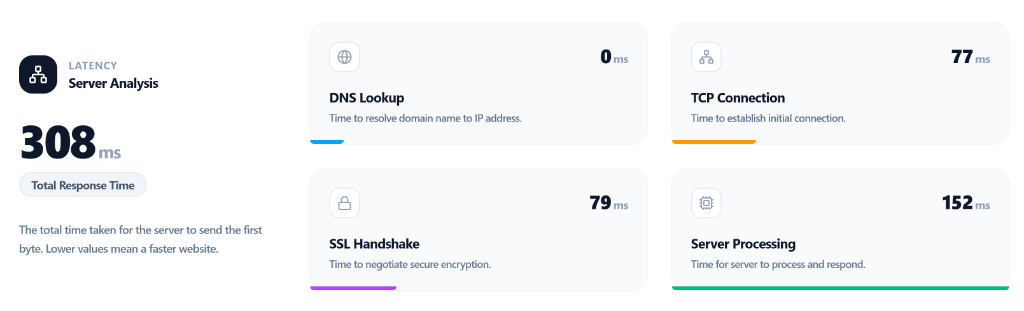
Quantitative Analysis: Geographic Latency Delta
The following data highlights the 'Latency Delta' ($\Delta$) between DNS resolution and TCP connection. A high $\Delta$ indicates a heavy reliance on edge-network DNS (Anycast) masking a distant physical origin.
| Region | TCP Latency ($\mu$) | $\Delta$ (vs DNS) | Network Topology Implication |
|---|---|---|---|
| Turkey (TR) | 8ms | +1ms | Local Origin (Minimal Latency) |
| United Kingdom (GB) | 48ms | +7ms | Direct Fiber Path |
| Netherlands (NL) | 65ms | +6ms | Standard RTT |
| Germany (DE) | 72ms | +4ms | Optimized Routing |
| USA (US) | 142ms | +79ms | Trans-Atlantic Origin |
| Japan (JP) | 345ms | +3ms | Physical Distance Limit |
The 'Anycast Masking' Phenomenon
The significant divergence observed in US-based providers (DNS: 63ms vs TCP: 142ms) illustrates the 'Anycast Mask'.
- The Mechanism: Anycast nodes in Europe resolve the IP address locally ($T_{dns} \approx 60ms$).
- The Constraint: The actual application data resides in North America. The TCP handshake must traverse the Atlantic fiber cables, incurring a physical latency penalty of approx. 80ms.
This confirms that while Edge Networking effectively optimizes name resolution and static content delivery, it cannot circumvent the speed of light for dynamic application states requiring origin-server communication.
Implications for Application Performance
For static content, this latency hidden by CDN hits. However, for dynamic applications (e.g., WooCommerce checkouts, membership user dashboards), the Transport Layer latency becomes the bottleneck. A fast DNS lookup cannot compensate for a slow TCP handshake in strictly dynamic environments.